The promise of dual PI3Kδ + JAK inhibition provides hope for JAK nonresponsive patients
Myelofibrosis (MF) remains one of the most challenging blood cancers, with too many patients facing limited options and uncertain futures. At iOnctura, our mission is to change that narrative by advancing innovative approaches to treat the disease.
The recent American Society of Hematology meeting marked an important moment for our team as we shared nonclinical data validating the rationale for our recently initiated study of roginolisib in MF. Our novel approach is to combine roginolisib, a next-generation PI3Kδ inhibitor, with ruxolitinib, a standard-of-care Janus kinase (JAK) inhibitor used in myelofibrosis. This dual-targeting strategy is designed to overcome resistance and deliver more durable outcomes for MF patients.

Myelofibrosis patients need more treatment options
MF is a complex, debilitating blood cancer. The disease is driven by overactive signaling that fuels inflammation, bone‑marrow scarring, and relentless symptoms – from severe fatigue and anemia to painful spleen enlargement. For more than a decade, JAK inhibitors have been the cornerstone of therapy, offering symptom relief and spleen volume reduction. Yet by year three of treatment, nearly 50% of patients discontinue JAK inhibitor therapy, driven by disease progression, adverse events and intolerance[1].
For patients and clinicians alike, this is a clear signal that the current treatment options are not enough.
Why combine PI3Kδ and JAK inhibition?
MF does not arise from a single faulty pathway. While JAK‑STAT dysregulation is central, parallel signaling routes can sustain malignant cell survival and drive resistance. In MF and related myeloproliferative neoplasms, PI3K signaling, especially the δ isoform relevant to hematologic disease, has been implicated downstream of JAK activity and as a contributor to loss of response[2]. Targeting both pathways together is scientifically compelling: hit the disease on two fronts to restore or amplify clinical benefit.
Roginolisib represents a new generation of PI3Kδ inhibition. Unlike previous PI3Kδ inhibitors, which faced limitations due to tolerability challenges, roginolisib employs a differentiated binding mechanism that results in highly precise targeting of PI3Kδ. This precision has been associated with few side effects for patients in early clinical studies (<7% grade 3/4 treatment-emergent adverse events (TEAEs)). Unlike prior PI3Kδ inhibitors, roginolisib dosing did not require dose modifications or interruptions because of side effects. Encouragingly, in Phase I, roginolisib doubled the survival time of patients with uveal melanoma suggesting potential for patients with conditions like uveal melanoma and MF, where PI3Kδ plays a critical role.
Clinical research already supports this dual strategy. Prior combination studies with earlier‑generation PI3Kδ inhibitors demonstrated that PI3K blockade can enhance ruxolitinib responses in MF patients with suboptimal or waning benefit. This is an important proof of concept for dual‑pathway strategies[2].
Our approach: roginolisib + ruxolitinib (HEMA‑MED)
At iOnctura, we’re advancing roginolisib, alongside standard‑of‑care ruxolitinib in patients who are unresponsive to JAK inhibition. The Phase I/II HEMA‑MED study (NCT06887803) is a multi‑center, open‑label trial designed to evaluate safety, tolerability and early efficacy in approximately 26 patients across two parts: an initial cohort (Part 1) focused on safety of the combination, followed by an expansion (Part 2) to assess overall benefit‑risk.
Sharing our science at ASH
This weekend hosted the 67th Annual American Society of Hematology (ASH) annual meeting. New nonclinical data of roginolisib in MF were discussed: cells from MF patients were treated with either roginolisib or ruxolitinib alone, or in combination. The results showed that whilst roginolisib alone prevented MF cells from growing, the combination of roginolisib and ruxolitinib was synergistic – preventing more growth than expected from either drug alone. These results validate the rationale to advance roginolisib in MF and provides support for the ongoing HEMA-MED study.
What’s next
Enrollment & execution: HEMA‑MED is actively recruiting across European centers with clearly defined safety and clinical‑activity assessments.
Ongoing evidence generation: We will continue to share updates as the dataset matures, building on the trial‑in‑progress and non‑clinical insights presented at ASH.
Stay connected: For updates on MF and the broader development of roginolisib across hematologic and solid tumors, subscribe to our News & Views.
Sources
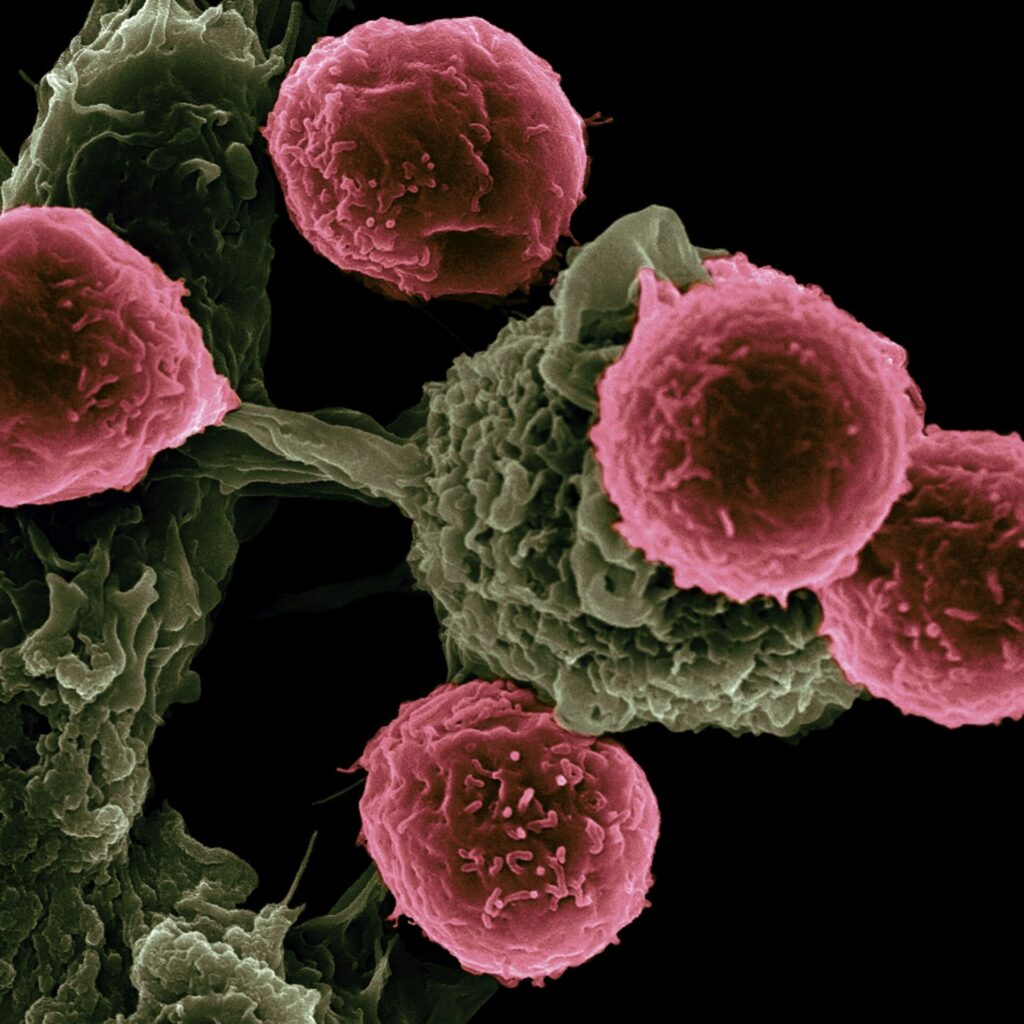
Photo by National Cancer Institute on Unsplash